

Avenue x Nomad: the battle for the new Brazilian investors
Fintechs are "breaking the frontiers" to helping the new Brazilian financial generation.

In the past, only billionaires (and millionaires) were able to invest outside Brazil.
Not only more.
Fintechs like Avenue and Nomad are battling to help Brazilians interested in diversifying investments, protecting assets, and investing in global markets. Their focus? The young people who want to buy Tesla, Facebook, Adobe and those famous international stocks.
It's a new world.
Avenue, the pioneer in this segment, was founded by Roberto Lee, a serial entrepreneur with strong history in Brazilian financial market. Lee sold the brokerage platform Clear to XP Inc. in 2014.
Nomad, on the other side, was created by a group of famous investors and successful Brazilian entrepreneurs.
Two high-level teams.

These two companies are the most famous solutions among the young Brazilians (Millennials and Gen X), but there's another dozen of solutions trying to participate in this party. Other good cases, just to mention, are Wise (the famous english fintech) and the traditional houses like XP Inc. and BTG.
The liquid society
A significant number of young Brazilians are not only interested in buying cars, or buy houses. Zygmunt Bauman (1925-2017), an extraordinary philosopher, said that the world is becoming a liquid society. One of the marks of liquid modernity is the process of individualization. In contrast to earlier periods where social identity was largely shaped by collective affiliations, individuals in liquid modernity are expected to construct their own identities.
I have a son of 24 and a daughter of 17. I am watching them working, studying and learning to make money very close. They and their friends have a different mindset to manage money, and the relationship with possessions is very, very different from ours.
Younger people are living in a liquid society.
In our view, Avenue and Nomad are well positioned: fast-growing, sexy marketing and excellent product (we tested all the solutions mentioned in this post).
Wise, for example, is focused on people traveling and Brazilians interested in sending money worldwide. It's a very common solution for students receiving money from parents to manage monthly expenses.
Kristo Käärmann, CEO of Wise, gave an interview to the portal Neofeed and reveals an important strategy to amplify the focus to startups and companies. It's a risky move. We know Brazil very well: "Build for people or build for companies." Conta Simples, the leading corporate bank focused on supporting middle and enterprise companies, isn't interested to having people as customers.
Let's be honest, Wise has a good presence in Brazil.
XP Inc. (NYSE: XP) and BTG (B3: BPAC11) are preferred by people escaping from the traditional banks. Baby boomers and rich people trust more to use institutions like these two.
EY has an important vision about new generations consuming financial services, and the Nubank (NYSE: NU) effect, is more than a proof that our market is changing.
Nubank makes a real disrupt in the Brazilian financial market. The bank (founded in 2011) has reached 100 million customers. It's phenomenal!
“The next generation of professionals wants to experiment and experience a variety of different roles, which will help them develop as many skills as possible.”
Stefanie Coleman - EY Director, People Advisory Services, Young LLP
“The idea that Gen Z professionals would embrace one career for life, perhaps like their parents did, has been debunked. Instead, they are pursuing “episodic” careers that are rich and varied. Their work preferences and expectations have changed dramatically since the pandemic – and they are not afraid to buck some norms to get what they want”, says Stefanie Coleman (EY Director).
Millions of young people are seeking to work globally, and this changes everything in financial services. This is the vision of EY, Nubank and all types of fintechs as we know.
Avenue and Nomad were born for this new generation.
The battle of the best experience and product
I give much credit to a product built with a good UI/UX. Avenue and Nomad have a good experience in both. In my opinion, even in fintech apps, where security is the main feature, the easiest KYC (know your customer), ease to make transactions, and understanding the numbers, are the mandatory features to use a bank. Especially, an international bank with numbers in other currencies.
Simple is hard to make in technology. So, I congratulate Avenue and Nomad. They understand very well the necessities of the new generation.
The bad news: both of the fintechs are not able to invest in or buy in cryptocurrencies directly.
Avenue has the focus on trading international stock and has a good portfolio of financial products. It's really simple to invest in the platform; it's easy to search stocks, funds, bonds and the dashboards, have a good user interface. It's very simple to exchange currencies in the app.
The fintech has an important detail in their history: after raising U$25 million with VC funds, Itau (the biggest Brazilian bank) bought an important stake (35% of shares) of the fintech. This partnership with Itau has an important advantage in terms of distribution (Avenue is being pushed inside Itau app), and Itau has big money to finance the Avenue strategy.
Nomad is focused in customer experience to use money outside Brazil: Nomad's credit cards are very good, complete and give the user, all they need. It's very simple to invest money and easy to open an account, like Millennials like.
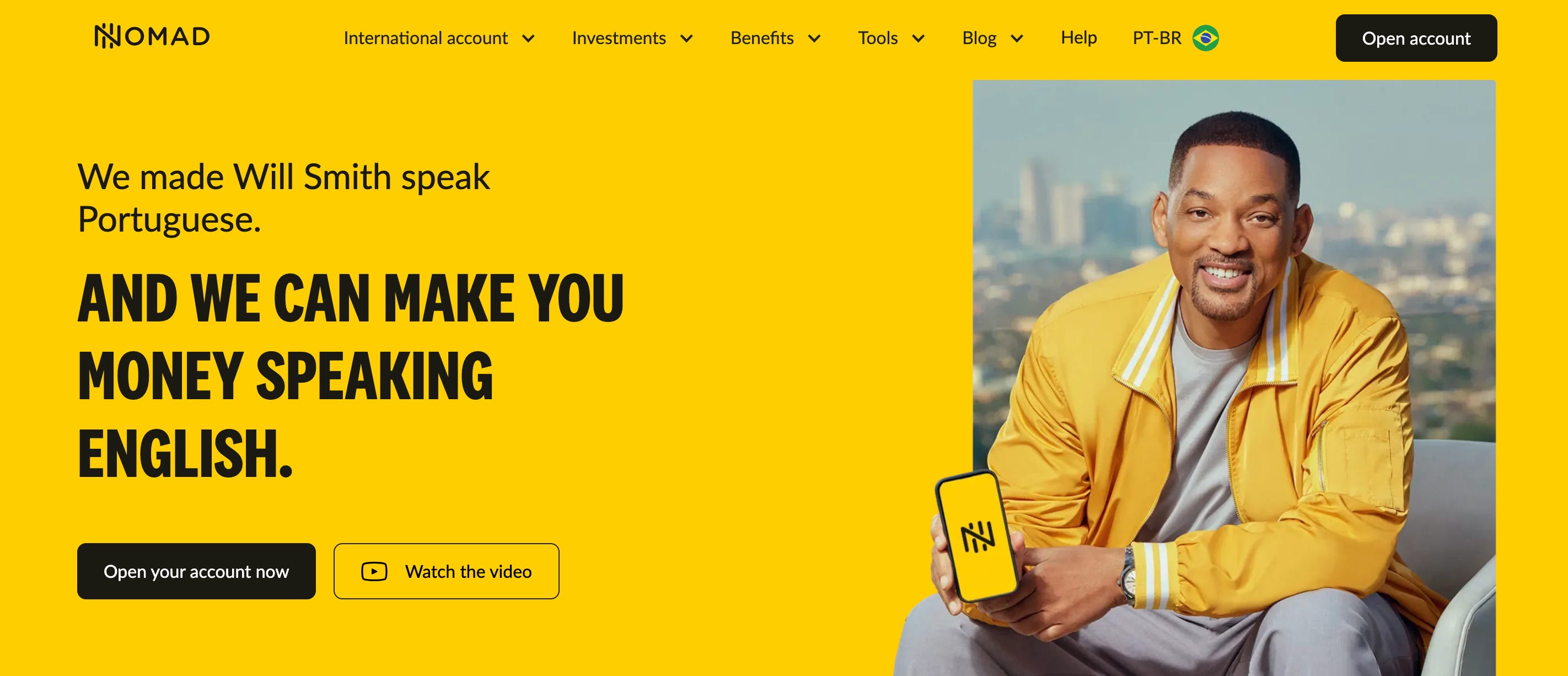
Recently, the fintech announced the superstar Will Smith as their “poster boy.” Impressive!
I am a huge fan of Nomad's marketing.
Nomad acquires two companies to improve the strategy: the Brazilian startups Melhor Câmbio (exchange fintech) and Husky (a money transfer app). Until now, Nomad raised U$197 million with VC funds.
Brazil currently has 70 million people under 20 years old.
This battle just begins.